From logistic regression to AI
Explores the evolution from simple logistic regression to modern AI, comparing model complexity, data requirements, and the surprising effectiveness of large neural networks.
John D. Cook provides expert consulting in applied mathematics and data privacy, helping clients from tech, biotech, and legal industries—including Amazon, Google, Microsoft, and Amgen—solve complex problems efficiently.
44 articles from this blog
Explores the evolution from simple logistic regression to modern AI, comparing model complexity, data requirements, and the surprising effectiveness of large neural networks.
Explores the challenges of getting consistent, reliable answers from AI models like ChatGPT due to prompt sensitivity and hidden variables.
Discusses the reliability challenges and lack of provable correctness guarantees in current AI systems, despite their productivity benefits.
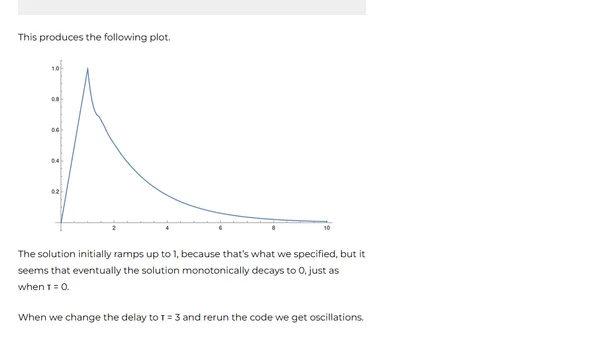
Explores how small delays affect differential equations, comparing behavior with and without delays using mathematical analysis and examples.
Explains the bash shell shortcut ~- as a handy alternative to $OLDPWD for referencing the previous working directory.
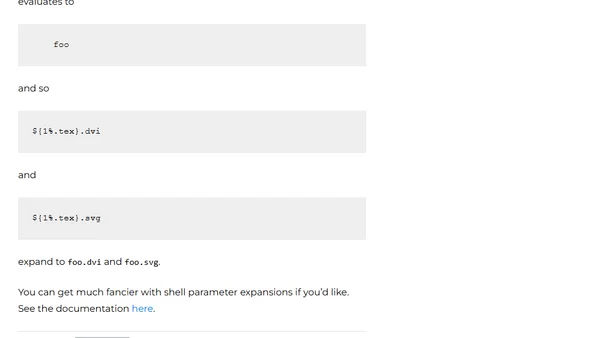
Explains how to manipulate file extensions in bash scripts using shell parameter expansion, with a LaTeX to SVG conversion example.
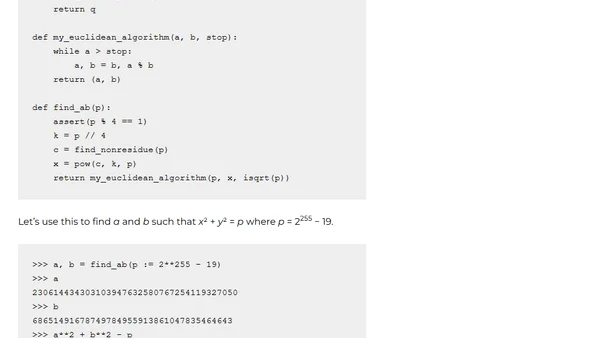
A technical guide implementing Wagon's algorithm in Python to solve x² + y² = p for large primes, using quadratic residues and a modified Euclidean algorithm.
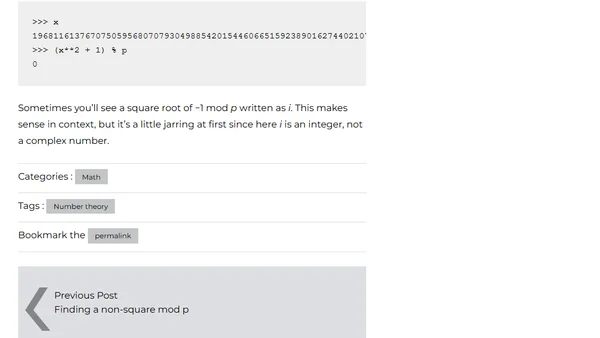
Explains how to compute a square root of -1 modulo a prime p, using number theory and Python code examples.
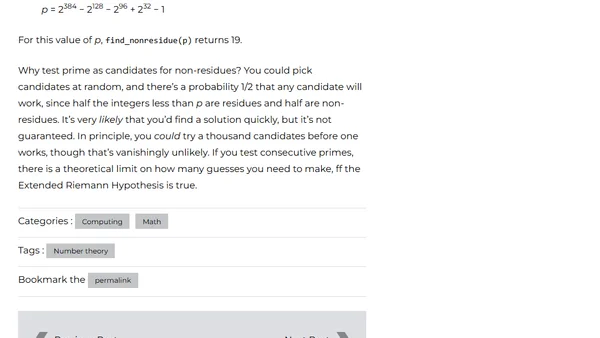
Explains an algorithm for finding a non-square modulo a prime, with Python code and examples from cryptography.
Explores Fermat's theorem on expressing primes as sums of two squares, comparing Gauss's formula with a more efficient computational algorithm.
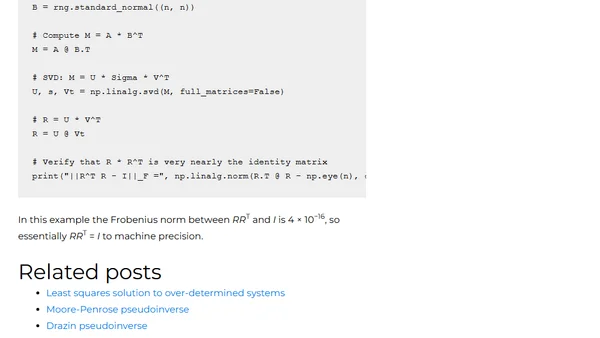
Explains the orthogonal Procrustes problem: finding a rotation matrix to align one matrix with another using SVD, with Python code.
Compares iterative vs. Binet's formula for computing large Fibonacci numbers in Python, analyzing performance and precision.
Explores space-time tradeoffs using Fibonacci numbers, comparing transmitting large numbers versus their indices and computational verification.
Explores the minimum value of sums of cosines with integer frequencies, touching on the Chowla cosine conjecture and numerical exploration methods.
Explains how eigenvalue problems in linear algebra homework are solved backward compared to real-world numerical methods.
Explains how to verify if a large number is a Fibonacci number using a mathematical certificate, relating it to computational proofs.
Explores the mathematical property that rounding up the gamma function of 1/n equals n, with a proof sketch and Python verification.
A mathematical analysis reveals that despite crowded visuals, there is immense volume per satellite in Low Earth Orbit, suggesting space is less congested than it appears.
Leading AI researchers debate whether current scaling and innovations are sufficient to achieve Artificial General Intelligence (AGI).
Explores the challenges of maintaining privacy when bridging assets between public and private cryptocurrency blockchains, highlighting metadata risks.