Fibonacci numbers and time-space tradeoffs
Explores space-time tradeoffs using Fibonacci numbers, comparing transmitting large numbers versus their indices and computational verification.
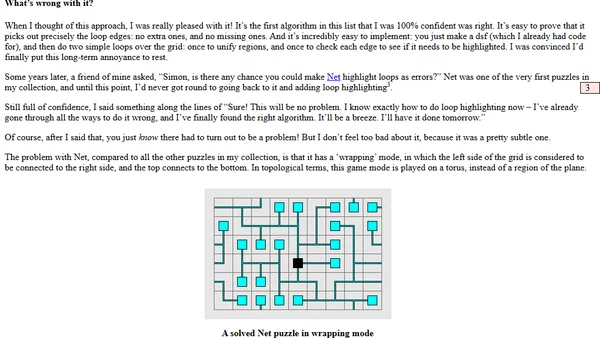
A deep dive into flawed algorithms for detecting loops in graphs, exploring common mistakes and why they fail in puzzle-solving contexts.
Explains the Boyer-Moore majority vote algorithm, a linear-time, constant-space solution for finding the majority element in a list.
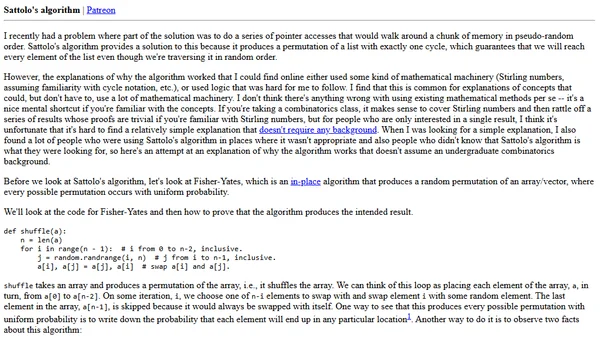
An explanation of Sattolo's algorithm for generating a random permutation with a single cycle, aimed at those without a strong math background.
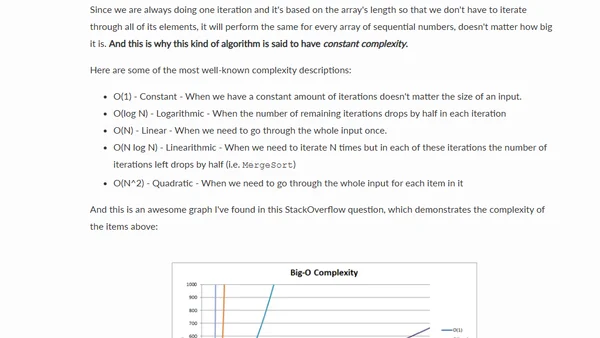
Explains Big O notation and algorithmic complexity, arguing why certain algorithms can't outperform a pigeon's efficiency.
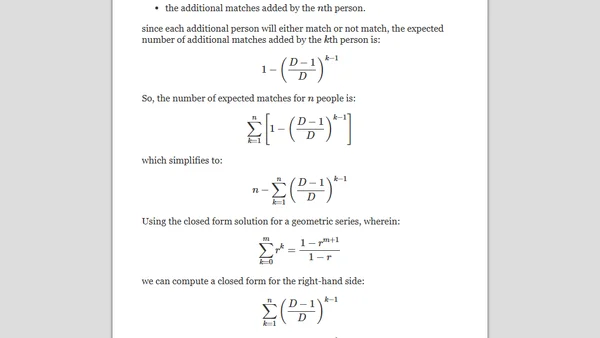
Explains how the birthday paradox applies to hash collisions, deriving the expected number of collisions in a set.
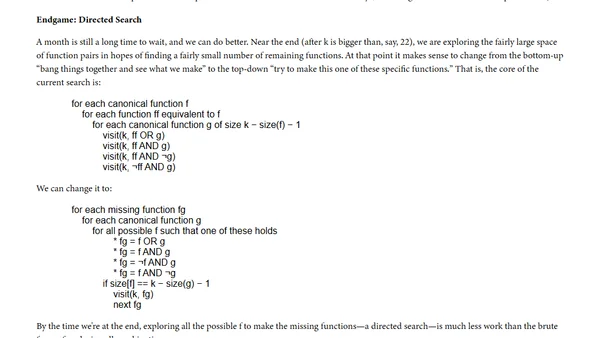
Explores the minimum number of AND/OR operators needed to express any Boolean function of five variables, detailing the computational approach.
A software developer contrasts the theoretical CS concepts learned in college with practical skills gained through professional and open-source work.