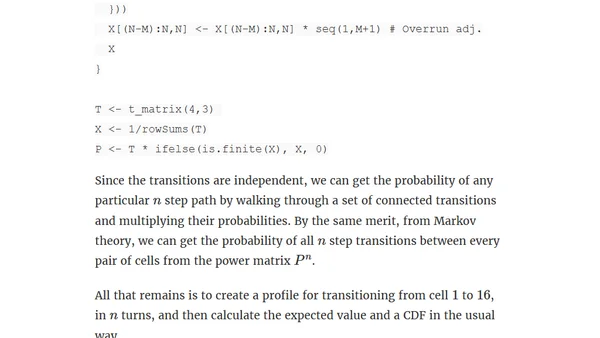
Snakes & ladders: a short statistical analysis
A statistical analysis of the classic board game Snakes & Ladders, modeling it as a Markov chain to calculate the expected game length.
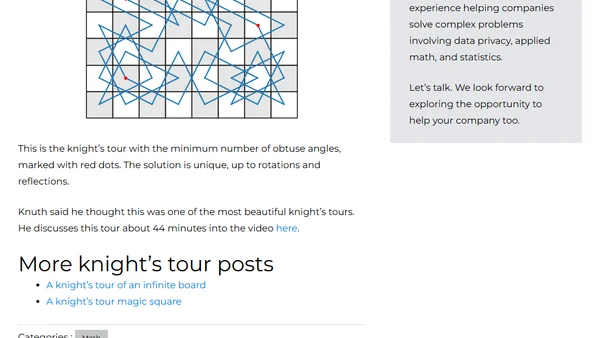
Analysis of a unique knight's tour with minimal obtuse angles, presented by Donald Knuth in his annual Christmas lecture.
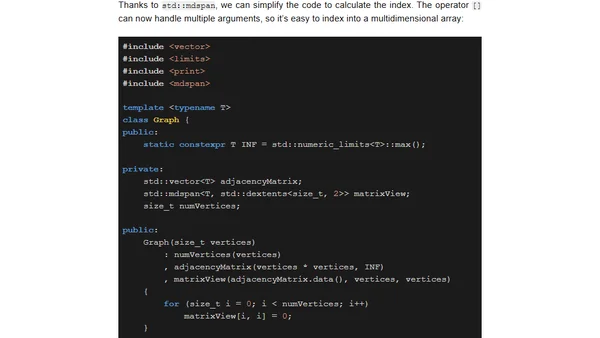
Explores implementing graph adjacency matrices in C++23, comparing vector-of-vectors to the new std::mdspan for better performance.
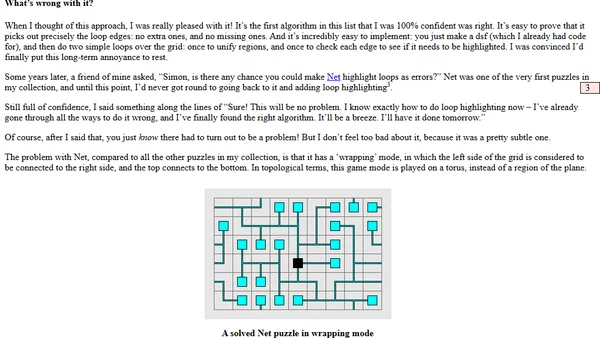
A deep dive into flawed algorithms for detecting loops in graphs, exploring common mistakes and why they fail in puzzle-solving contexts.
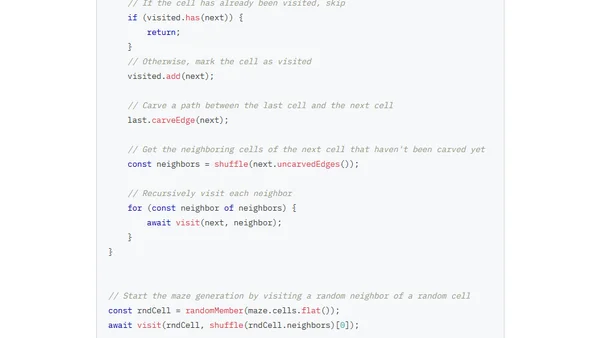
Explores algorithms for generating perfect 2D mazes, including Aldous Broder and Random DFS, with code examples and visualizations.
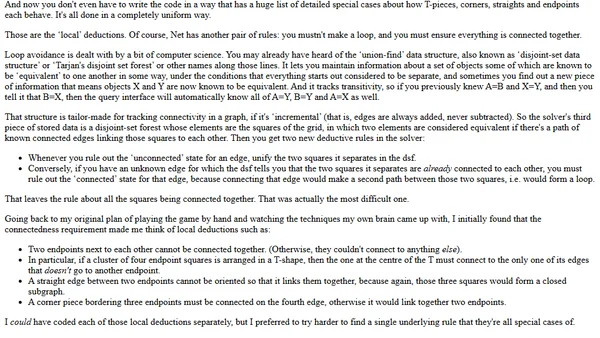
Simon Tatham explains his thought process and algorithm for writing a solver for the puzzle game Net, focusing on deduction and constraint propagation.
An introduction to graph theory using examples from Facebook, Game of Thrones, and social relationships to explain network concepts.
A roundup post celebrating the CRANniversary of the ggraph R package, highlighting its features and community tutorials for network visualization.