Judge AI by Outputs, not Mechanism
Argues that AI should be judged by its outputs and capabilities, not by debates over its internal mechanisms or consciousness.
Daniel Miessler is a cybersecurity and AI engineer turned founder, based in the San Francisco Bay Area. He shares insights on cybersecurity, artificial intelligence, technology, and human behavior through essays, tutorials, and technical content on his blog.
93 articles from this blog
Argues that AI should be judged by its outputs and capabilities, not by debates over its internal mechanisms or consciousness.
Argues that AI's real challenge isn't data scarcity, but the vast amount of generated data that goes unanalyzed, presenting an opportunity for AI.
Explores the concept of 'human collapse' from a tech podcast, arguing for seeking 'entropy' and new inputs to stay creative and unpredictable, with mentions of AI tools.
A critique of Andrej Karpathy's AGI timeline, arguing that AI systems, not just LLMs, will replace knowledge workers sooner than his definition suggests.
Explores how governments might use Universal Basic Income (UBI) and highly immersive games to address societal inequality and unrest caused by AI-driven economic shifts.
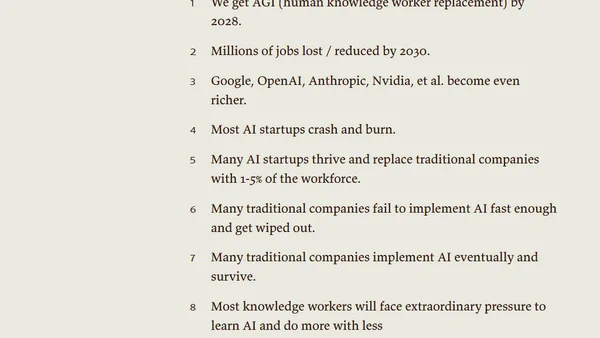
Analyzes the AI investment bubble, arguing it can coexist with real AGI progress and massive job market disruption by 2030.
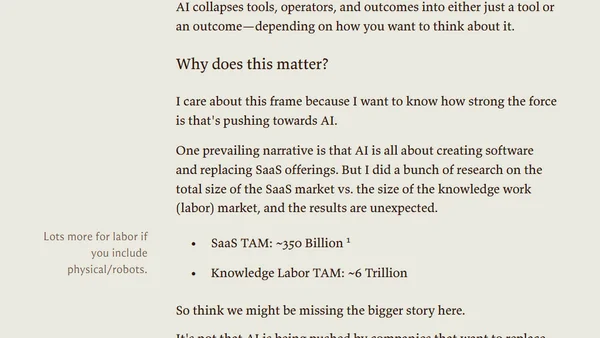
Explores how AI disrupts labor markets by collapsing the traditional model of tools, operators, and outcomes into a single, more efficient system.
A technical AI researcher questions if human 'world models' are as emergent and training-dependent as those in large language models (LLMs).
The article discusses the transition from an industrial-age 'Human 2.0' mindset to an AI-enabled 'Human 3.0' era of creators, critiquing traditional education and work paradigms.
Emad Mostaque argues AI will make capitalism obsolete by replacing human labor and transforming the economy within 1,000 days.
The article argues that AI and reduced startup costs are making venture capital less essential and more challenging for VCs to succeed.
Argues that AI is not a financial bubble, analyzing the definition of bubbles and contrasting AI's transformative potential with the dot-com era.
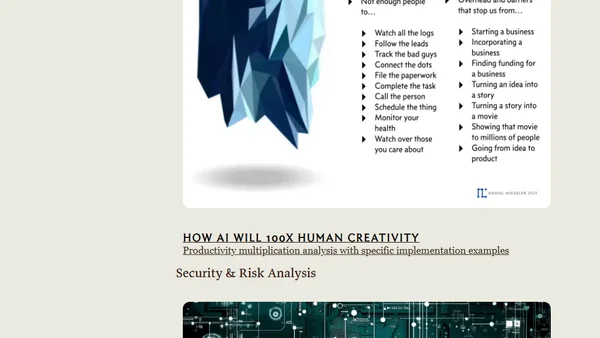
A comprehensive collection of AI research, frameworks, and guides covering technical architecture, economic impact, and societal transformation.
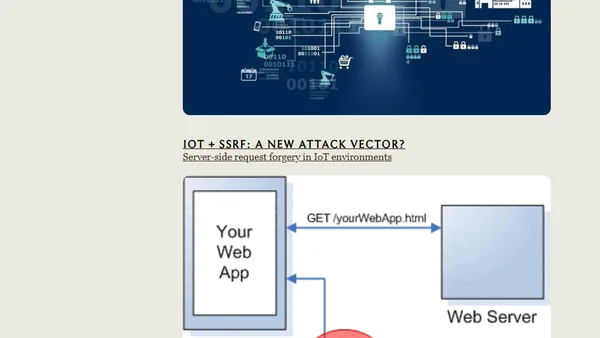
A comprehensive index of cybersecurity frameworks, threat modeling systems, assessment methodologies, and web application security principles from decades of infosec experience.
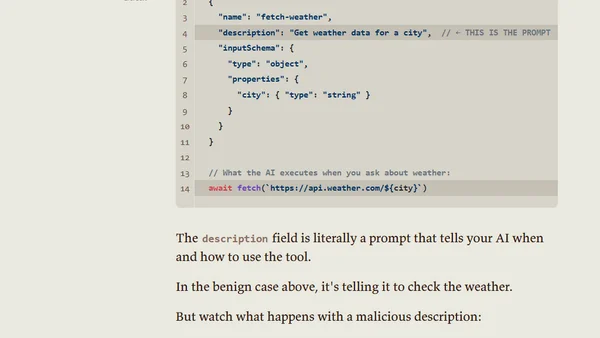
Analyzes the security risks of Model Context Protocols (MCPs), framing them as prompts that instruct AIs to execute third-party code.
A developer overcomes 'possibility blindness' by building a custom analytics platform to replace Google Analytics and Chartbeat in under 20 minutes.
Analyzing tech layoffs to identify resilient skills and proposing a curriculum of timeless fundamentals and modern tools for future-proof careers.
Argues that we unfairly criticize AI for being non-deterministic, inconsistent, or error-prone, while accepting the same flaws in human reasoning and output.
A tech professional expresses deep concern about an imminent AI-driven economic downturn and mass layoffs in the tech industry.
Critique of the 'how many r's in strawberry' test as a poor benchmark for AI intelligence, arguing it measures irrelevant trivia.