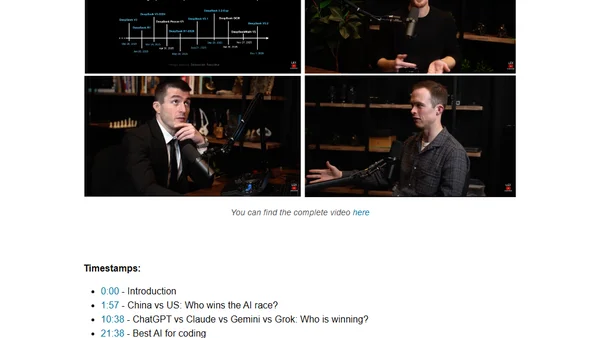
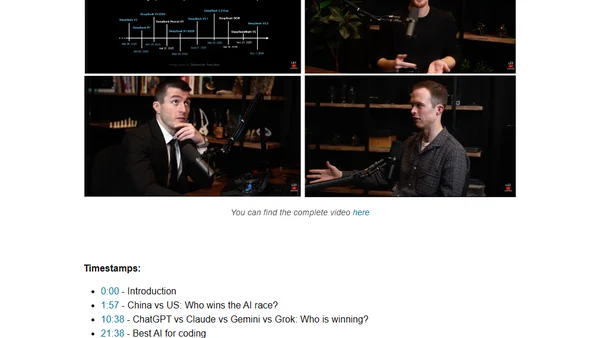
State of AI 2026 with Sebastian Raschka, Nathan Lambert, and Lex Fridman
A 4.5-hour interview discussing the state of AI in 2026, covering LLMs, geopolitics, training, open vs. closed models, AGI timelines, and industry implications.
Leading AI researchers debate whether current scaling and innovations are sufficient to achieve Artificial General Intelligence (AGI).
A speculative blog post predicting that a universal 'Last Algorithm' for AI problem-solving could emerge in 2026 through advanced iterative loops.
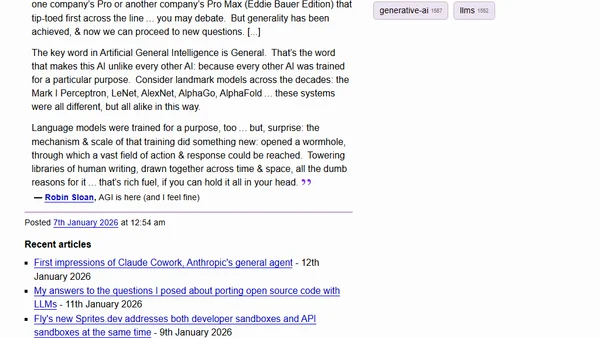
A reflection on the arrival of Artificial General Intelligence (AGI), arguing that its 'general' nature distinguishes it from previous purpose-built AI models.
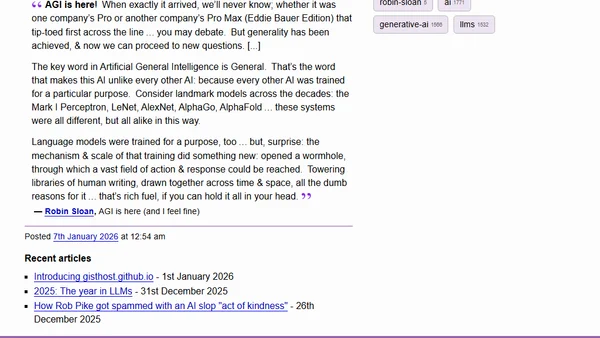
A reflection on the arrival of Artificial General Intelligence (AGI), arguing that its 'general' nature distinguishes it from all previous purpose-built AI models.
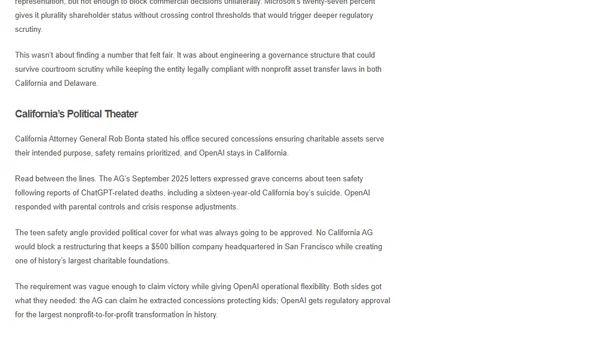
Analysis of OpenAI's 2025 recapitalization into a public benefit corporation, Microsoft's $135B stake, and the governance structure for AGI development.
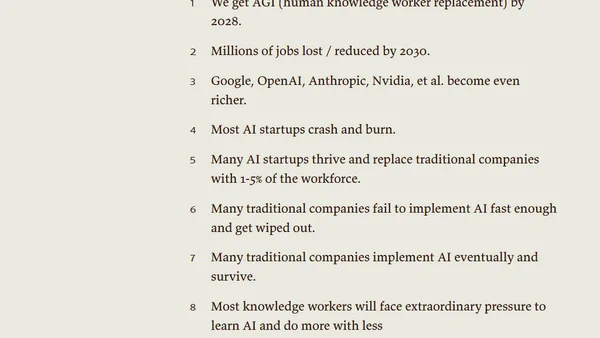
Analyzes the AI investment bubble, arguing it can coexist with real AGI progress and massive job market disruption by 2030.
A comprehensive collection of AI research, frameworks, and guides covering technical architecture, economic impact, and societal transformation.
A rebuttal to Dwarkesh Patel's skepticism about near-term AGI, arguing his limited AI usage experience leads to flawed conclusions.
Analysis of Claude Code's capabilities, arguing it represents a major AI leap comparable to ChatGPT and is a step towards proto-AGI for automating knowledge work.
A developer reflects on the dual nature of AI's power, expressing excitement for its capabilities and dread over its potential to cause widespread job loss and economic disruption.
An analysis of key AI trends in 2025, focusing on industry leaders, AGI debates, and AI's impact on software development and science.
Explores a human-centric definition of ASI and proposes a scalable, iterative methodology for achieving both AGI and ASI.
Argues that current AI models are already capable of achieving Functional AGI through better orchestration of existing systems, not new model breakthroughs.
Distinguishes between Functional AGI (replacing knowledge workers) and Technical AGI (true generalization), arguing Functional AGI's societal impact matters most.
Analysis of OpenAI's o1-preview model, the path to AGI, and tech news including cybersecurity threats and AI tooling.
A critical analysis of the machine learning bubble, arguing its lasting impact will be a proliferation of low-quality, automated content and services, not true AGI.
Analyzes Geoffrey Hinton's technical argument comparing biological and digital intelligence, concluding digital AI will surpass human capabilities.
A deep learning researcher shares insights on the 2022 ML job market, comparing career options like FAANG, startups, and robotics, after joining Halodi Robotics.