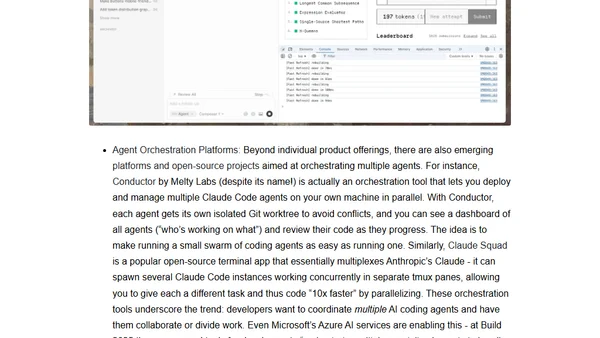
The future of agentic coding: conductors to orchestrators
Explores the evolution of AI coding assistants, where developers shift from coding to managing autonomous agents as conductors and orchestrators.
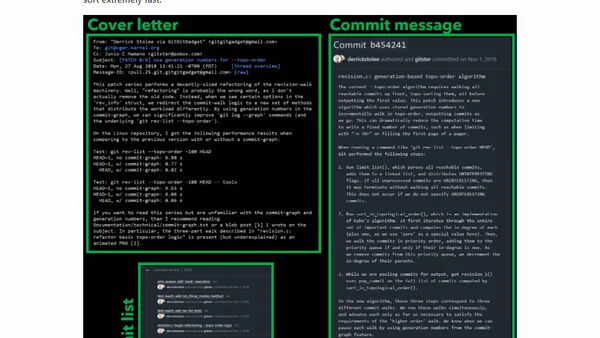
A guide on improving communication in pull requests to enhance code reviews and project understanding.
A retrospective on the growth and community-building efforts of the Python Pescara user group throughout 2025.
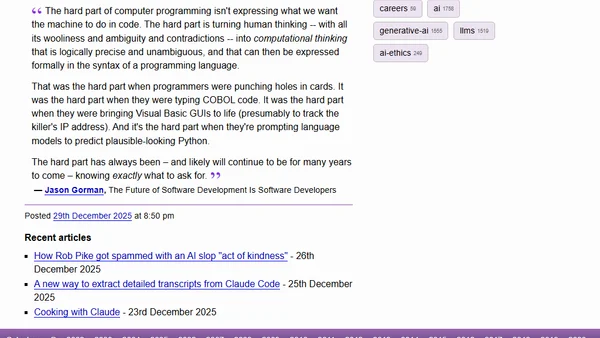
The core challenge of programming is translating ambiguous human thought into precise computational logic, not just writing code.
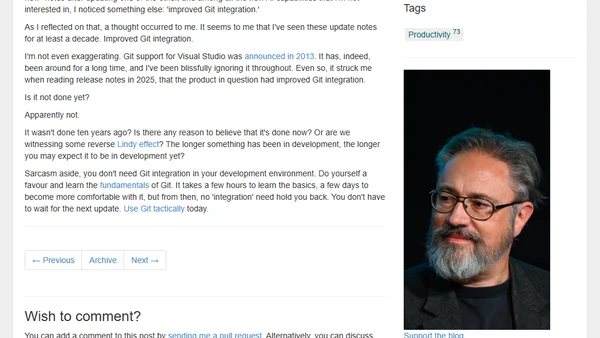
A critique of perpetual 'improved Git integration' in IDEs, arguing developers should learn core Git instead of waiting for tools.
Explores how AI will expand knowledge work by making tasks cheaper, leading to new projects and activities we don't do today.
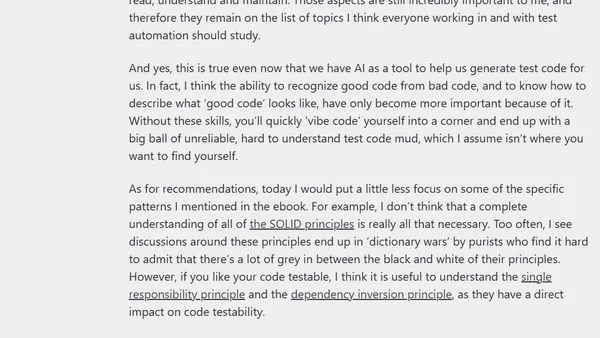
A review and refinement of the five fundamental pillars of test automation, emphasizing core principles over fleeting tool trends.
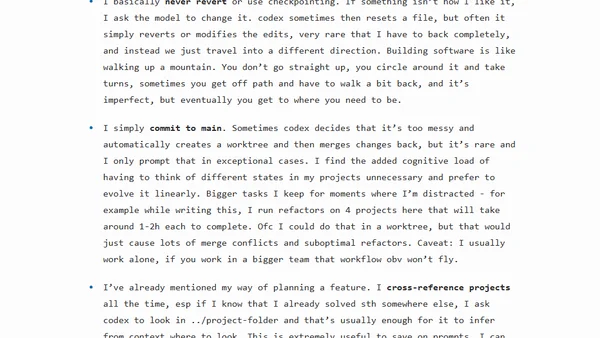
A developer's reflection on how AI coding agents, particularly GPT-5 and Codex, have dramatically accelerated software development by handling routine coding tasks.
Explores how AI prompts have evolved from simple text strings into critical, reusable system components with logic, and the challenges this creates.
A developer reflects on the anxiety and impact of using Large Language Models (LLMs) in programming, balancing skepticism with practical utility.
The author compares building a Blue Brixx advent calendar to modern software development, highlighting issues like poor documentation and fragile assemblies.
Explores using .goosehints files and the TODO extension with the Goose AI agent to plan and structure a festival countdown web app project.
A neurodivergent software engineer shares how AI tools like ChatGPT provide a judgment-free space for technical collaboration and problem-solving.
How AI is enabling individuals to build custom software for personal use, replacing paid apps and unlocking new creative potential.
A developer argues against using AI for every problem, highlighting cases where classic programming is simpler and more reliable.
Armin Ronacher reflects on 2025 as a transformative year where AI coding agents like Claude Code fundamentally changed his programming workflow and career.
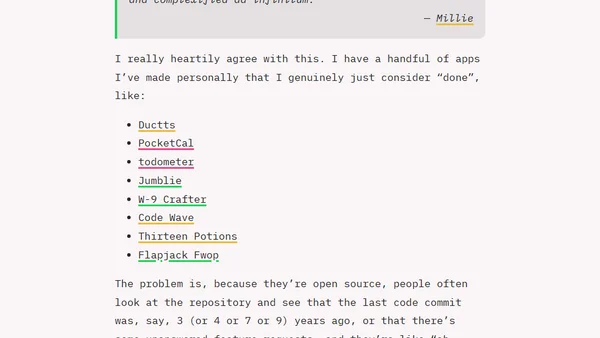
A developer argues for normalizing 'finished' software that works without constant updates, contrasting it with the expectation of perpetual maintenance.
A ColdFusion code kata exploring methods for conditionally formatting compound strings like names and addresses, comparing brute-force logic with list functions.
A software engineer explains their decision to stay on Substack for blogging, prioritizing community engagement and reducing writing friction over platform controversies.
Simon Willison critiques the trend of developers submitting untested, AI-generated code, arguing it shifts the burden of real work to reviewers.