Probably the realest thing I ever wrote
A software engineer reflects on the importance of mentoring and delegating to avoid becoming trapped in a critical role, advocating to 'code yourself out of the job'.
Explores how AI-generated code creates 'cognitive debt'—a loss of system understanding—which can paralyze developers more than technical debt.
Explores how AI-assisted coding creates a bottleneck in code review, comparing it to historical industrial constraints and questioning sustainability.
A daily tech reading list covering AI-generated code, tech debt, AI's impact on work, and updates on tools like Go 1.26 and Vertex AI.
Explains the three key growth curves—exponential, linear, and logarithmic—that define a scalable software business and an engineer's role in building long-term assets.
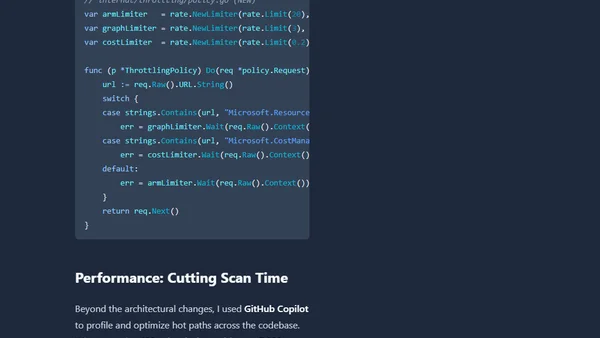
A developer details using GitHub Copilot's plan and agent modes to refactor the Azure Quick Review tool, eliminating technical debt and improving performance.
A daily tech reading list covering AI adoption, technical debt, new developer tools, and industry trends from Google, Anthropic, and more.
Explores the reality of managing legacy code and continuous migration in production software, emphasizing adaptability over perfect design.
A software architect introduces 'The Law of Collective Amnesia' to explain how system design intent fades over time and offers strategies to defend architecture.
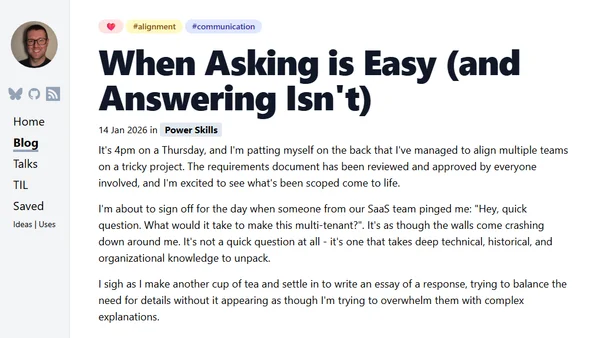
Explores the challenge of 'asymmetric questions' in tech teams, where asking is easy but answering requires deep effort and context.
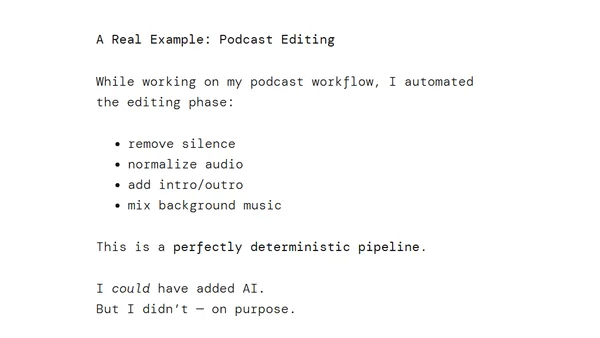
A developer argues against using AI for every problem, highlighting cases where classic programming is simpler and more reliable.
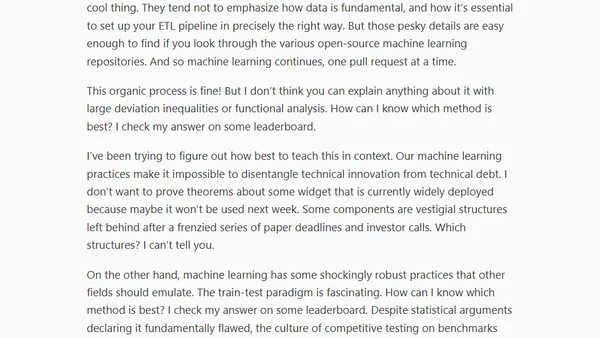
A lecture reflection on the gap between mathematical theory and practical engineering in machine learning, arguing for social analysis over functional analysis.
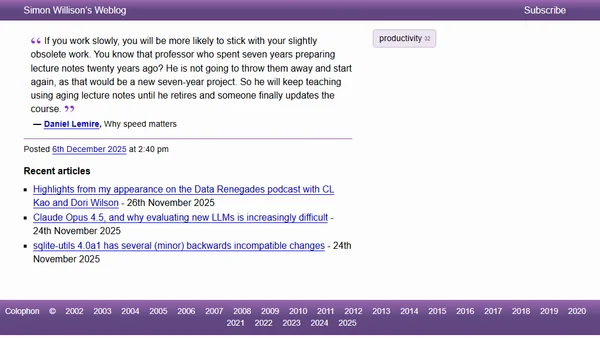
A blog post discussing the importance of speed in technology and work, referencing Daniel Lemire's insights on avoiding obsolescence.
A critique of AI's role in software development, arguing that output is not productivity and that expertise remains essential for solving real problems.
Explores the deeper lesson of Chesterton's fence in software engineering: understanding why code exists, then deleting it if it's obsolete.
A developer shares lessons on avoiding technical debt by prioritizing planning over coding, using a personal game project as an example.
A software engineer's reflection on managing priorities and technical debt in a fast-growing company, comparing it to spinning plates.
A software engineer's reflection on why buggy software is released, using personal anecdotes about frustrating apps and websites.
A curated list of articles exploring AI-assisted development, covering real-world integration, career impacts, failed experiments, and technical deep-dives.
Explores how tech debt in infrastructure code creates a self-perpetuating 'flywheel' effect, making it extremely costly and difficult to fix.