Giving Good Feedback: Consider the Ratio
A guide on giving effective feedback in tech teams, emphasizing the importance of balancing critique with specific, meaningful praise.
Strategies for managing and documenting team knowledge to improve collaboration, decision-making, and onboarding of new members.
Explores why complex ideas and systems are often favored over simpler ones in tech and academia, and argues for the advantages of simplicity.
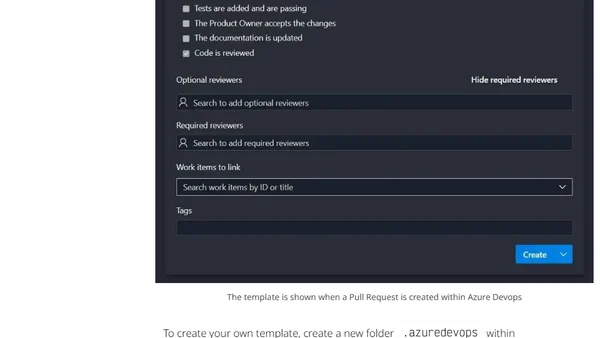
How to use an Azure DevOps Pull Request template to enforce a team's Definition of Done and improve code review quality.
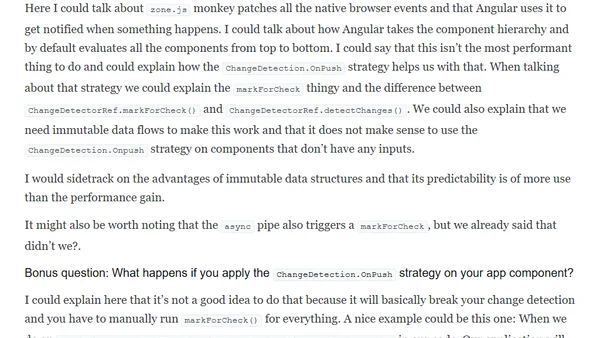
A guide to effective Angular interview questions for senior developers, focusing on open-ended questions to assess problem-solving over API memorization.
Learn how to implement and use the Python logging module to monitor events and analyze application performance.
A guide to manually tackling tedious software development tasks like linting and dependency upgrades, and when brute force is the right approach.
Analyzes why daily stand-ups often fail in software teams and provides actionable advice to fix them by refocusing on core Agile principles.
A guide on defining your target audience for technical documentation and books to create focused and effective writing.
Explores how embracing uncertainty in software product development can lead to greater profitability, using betting analogies to explain economic principles.
A software development analogy comparing building a house to building websites, emphasizing the need for upfront planning for accessibility and performance.
A monthly update on TinyPilot, covering business metrics, goal progress, and the viral success of a blog post about a $46k website redesign.
A developer's perspective on the challenges of implementing authorization (authz) in software, balancing minimal effort with security needs.
A satirical critique of over-engineered Agile frameworks, proposing the simple 'Talk To Your Customers' (TTYC) methodology as a disruptive alternative.
A guide to writing constructive and polite code review comments on pull requests, emphasizing clarity and empathy.
A developer argues for using a combination of tabs and spaces for code indentation, focusing on accessibility and developer preference.
Discusses the importance of conciseness and direct communication in software development and open-source communities.
Argues against prematurely squashing/rebasing PRs before review, explaining how it hinders reviewers and suggests using 'Squash and merge' on merge instead.
A tech worker discusses the role of privileged individuals in the tech industry in pushing for climate action and systemic change.
Explores why designing human processes around extreme edge cases, unlike software, often creates pathological and counterproductive systems.