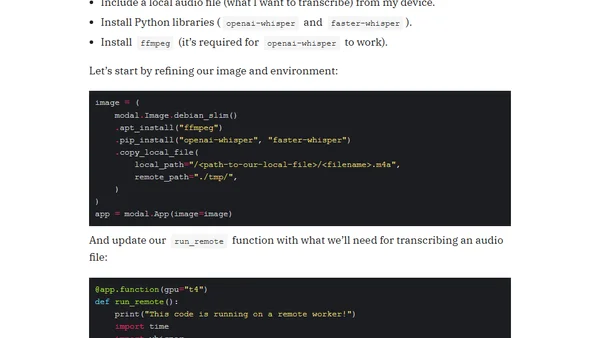
Running Python on a serverless GPU instance for machine learning inference
A guide to running Python code on serverless GPU instances using Modal.com for faster machine learning inference, demonstrated with a speech-to-text example.
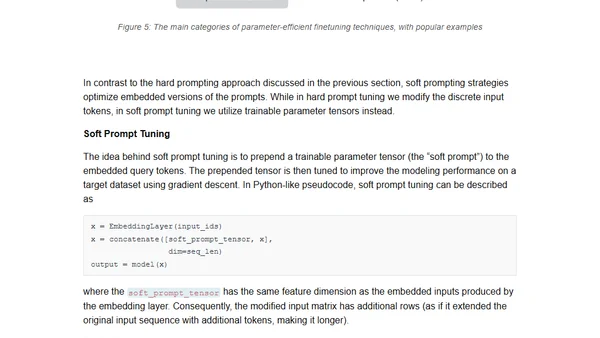
Explores methods for using and finetuning pretrained large language models, including feature-based approaches and parameter updates.
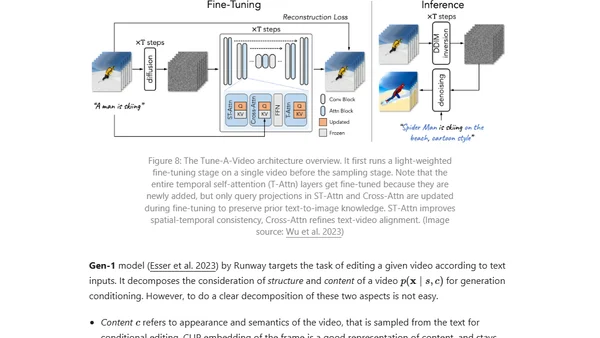
Explores the application of diffusion models to video generation, covering technical challenges, parameterization, and sampling methods.
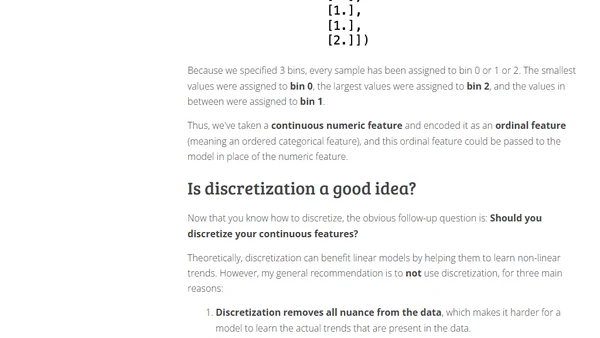
Explores the pros and cons of discretizing continuous features in machine learning, with a practical guide using scikit-learn's KBinsDiscretizer.
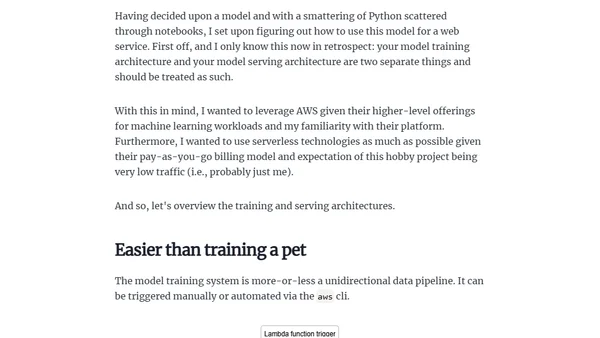
A developer's journey building a TV show recommendation engine using AWS SageMaker, from data collection to model deployment.
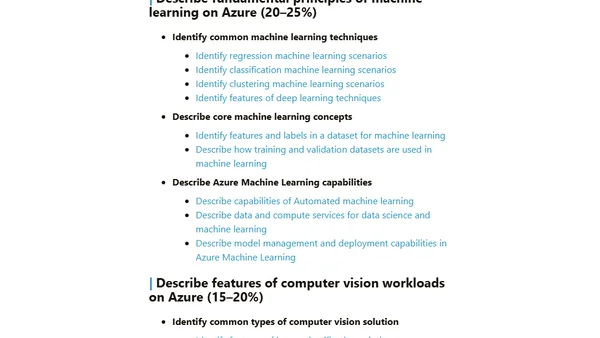
A study guide for the Microsoft AI-900 Azure AI Fundamentals exam, covering AI workloads, machine learning, and generative AI.
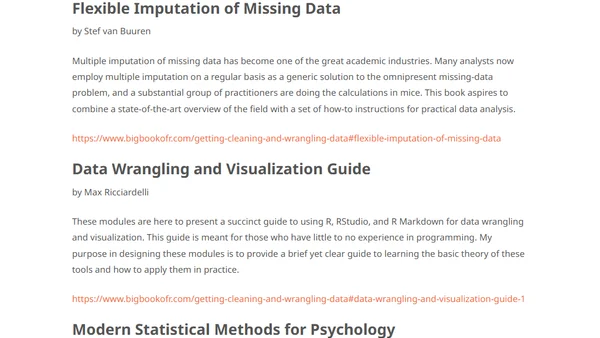
Announces the addition of 6 new R programming books to the Big Book of R collection, covering statistics, machine learning, and data science.
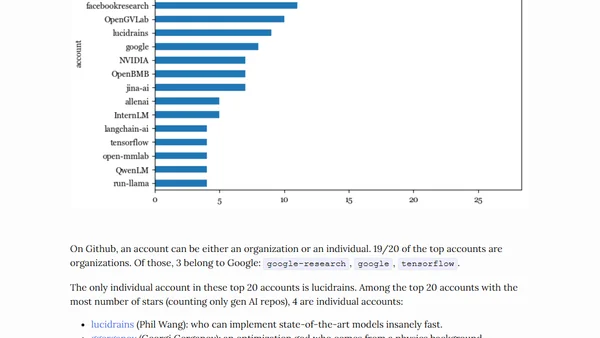
An analysis of 900 popular open-source AI tools, categorizing them into infrastructure, model development, and application layers.
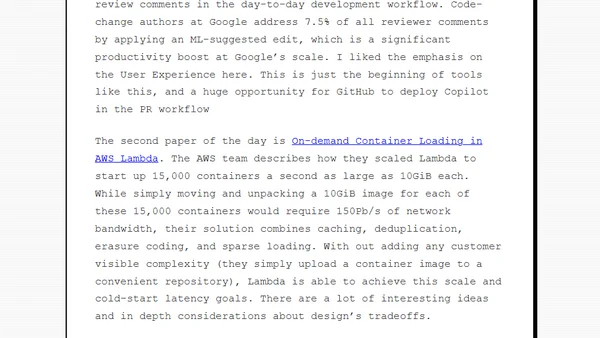
A monthly tech digest covering Meta's DotSlash tool, AI-powered code reviews, AWS Lambda scaling, observability trends, and Cloudflare's logging pipeline.
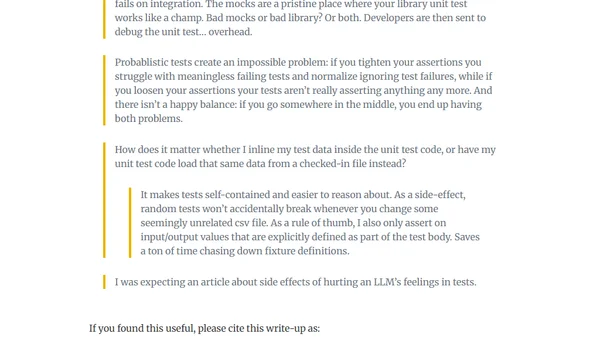
Explains why mocking ML models in unit tests is problematic and offers guidelines for effectively testing machine learning code.
Explores the gap between generative AI's perceived quality in open-ended play and its practical effectiveness for specific, goal-oriented tasks.
Explores the importance of high-quality human-annotated data for training AI models, covering task design, rater selection, and the wisdom of the crowd.
Explains key AI model generation parameters like temperature, top-k, and top-p, and how they control output creativity and consistency.
Analyzes push notifications as a recommender system, discussing intent, personalization, timeliness, and user engagement challenges.
A recap of key announcements from the second half of AWS re:Invent 2023, focusing on new AI/ML services and management tools.
Explores how AI and LLMs can enhance CI/CD pipelines by predicting test failures, generating tests, enabling intelligent rollbacks, and detecting anomalies.
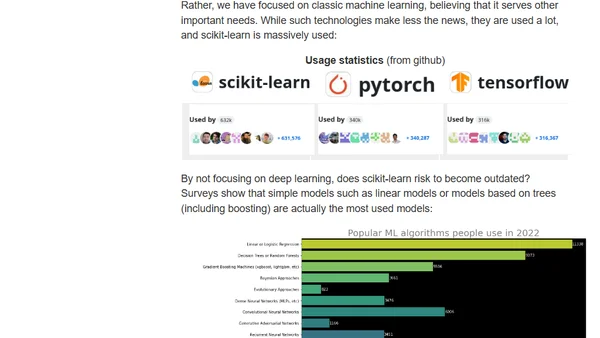
Scikit-learn remains a dominant and impactful machine learning library, especially for classic ML and tabular data, despite the hype around deep learning.
Announcing libactivation, a new Python package on PyPI providing activation functions and their derivatives for machine learning and neural networks.
Exploring how Java code can be executed on GPUs for high-performance computing and machine learning, covering challenges and potential APIs.
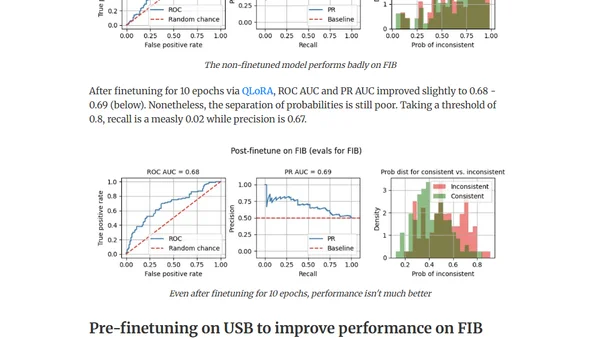
Explores using out-of-domain data to improve LLM finetuning for detecting factual inconsistencies (hallucinations) in text summaries.