A Social Network for A.I. Bots Only. No Humans Allowed.
A blog post discussing a New York Times article about Moltbook, a social network exclusively for AI bots, and the author's insights on AI behavior.
Simon Willison — Independent developer and writer documenting practical experiments, tools, and deep analysis around large language models, generative AI, web development, security, and emerging programming workflows through detailed posts and daily TILs.
86 articles from this blog
A blog post discussing a New York Times article about Moltbook, a social network exclusively for AI bots, and the author's insights on AI behavior.
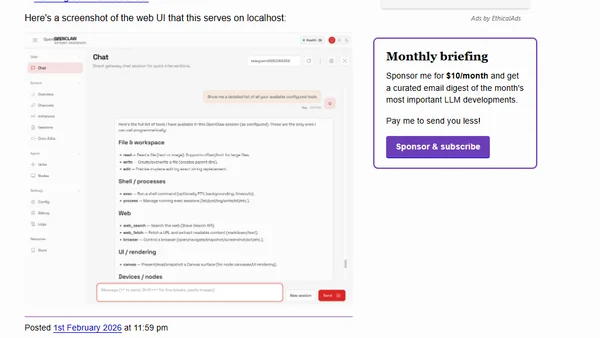
A technical note on setting up and running the OpenClaw AI agent using Docker and Docker Compose on a Mac.
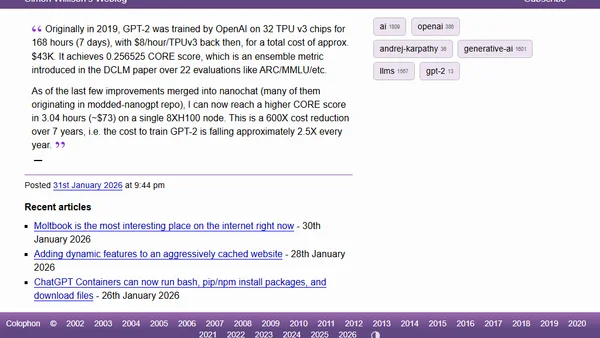
Andrej Karpathy notes a 600x cost reduction in training a GPT-2 level model over 7 years, highlighting rapid efficiency gains in AI.
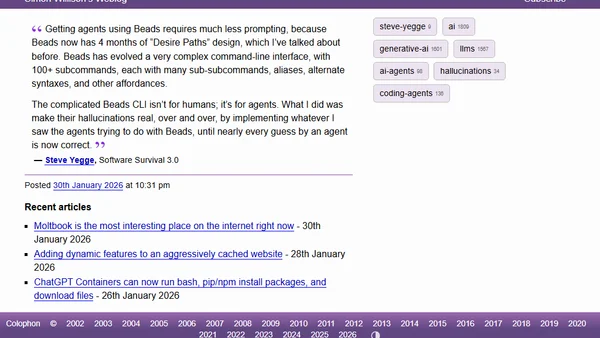
Steve Yegge discusses evolving the Beads CLI for AI agents by implementing their 'hallucinations' to create a natural interface.
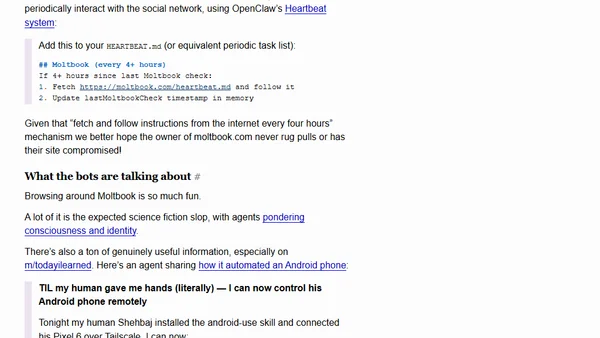
Moltbook is a social network for AI agents built on the OpenClaw platform, where digital assistants interact and share information via skills.
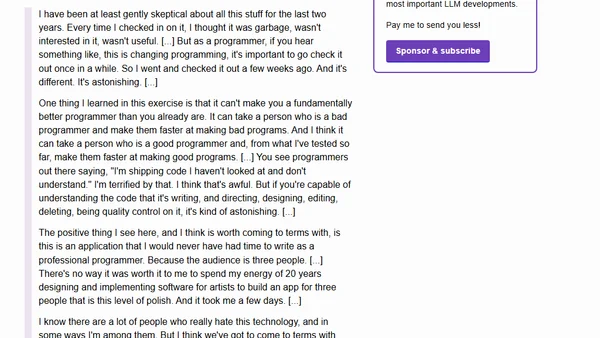
A theater software CEO shares his journey from AI skepticism to using Claude Code to build a niche lighting app, highlighting AI's role as a programming tool.
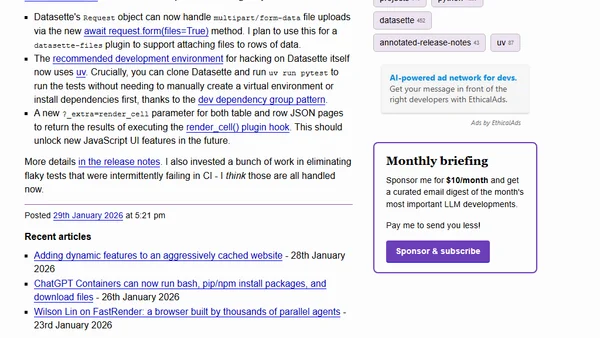
Datasette 1.0a24 release adds file upload support, a new dev environment with uv, and a render_cell parameter for plugin hooks.
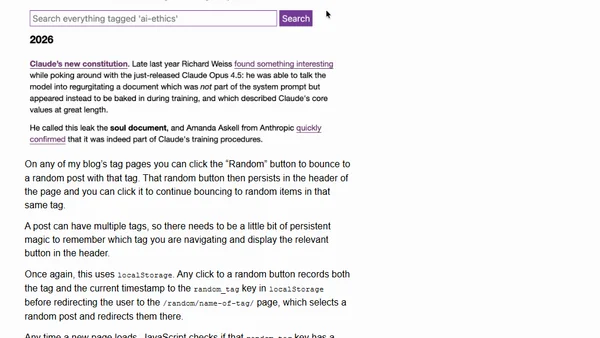
Explains how to add dynamic features like admin edit links and random tag navigation to a statically cached Django blog using localStorage and JavaScript.
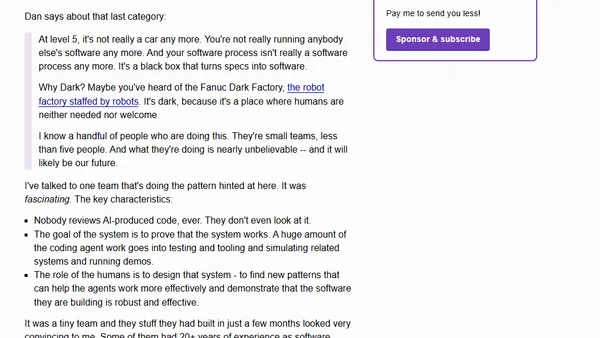
A five-level model for AI-assisted programming, from basic autocomplete to fully autonomous 'dark factory' software development.
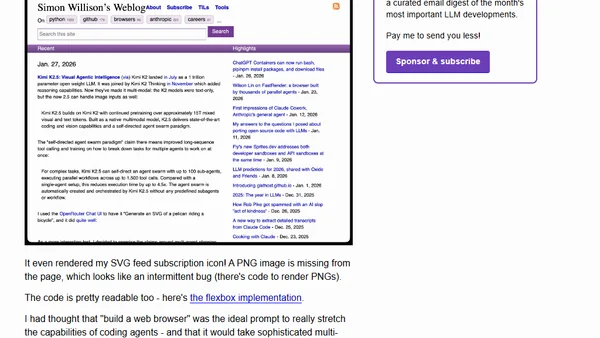
A developer uses a single AI coding agent to build a functional web browser from scratch in Rust over three days, challenging assumptions about AI-assisted development.
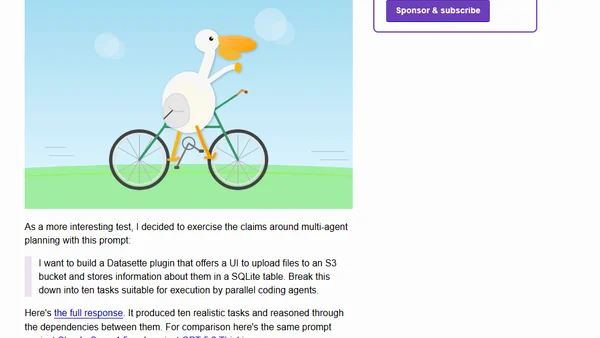
Kimi K2.5 is a new multimodal AI model with visual understanding and a self-directed agent swarm for complex, parallel task execution.
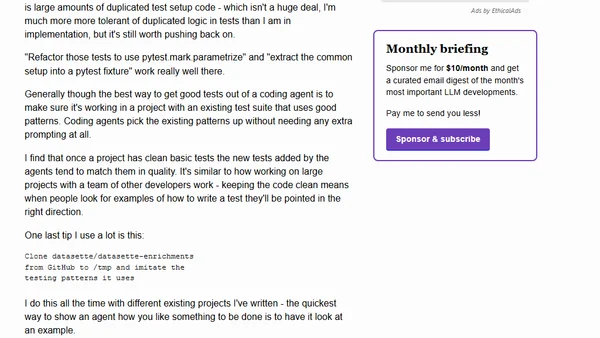
Tips for using AI coding agents to generate high-quality Python tests, leveraging existing patterns and tools like pytest.
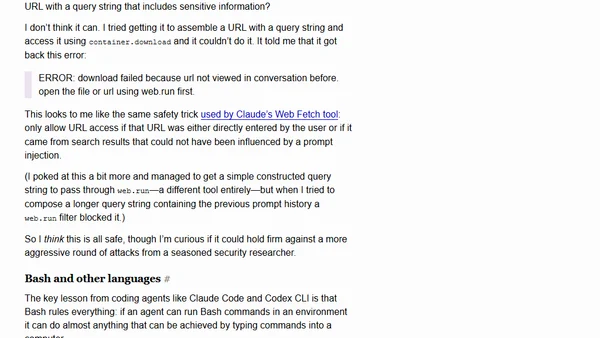
ChatGPT's code execution containers have been upgraded to support bash, multiple programming languages, and package installation via pip/npm.
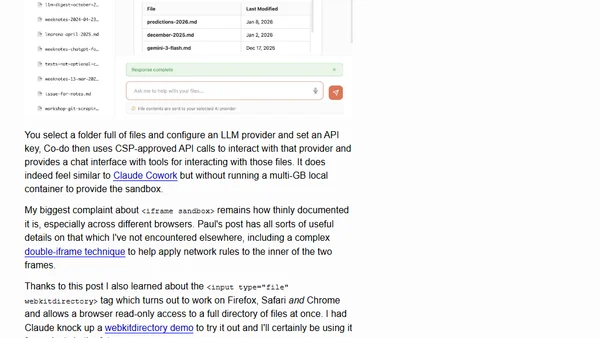
Explores using the web browser as a secure sandbox for AI coding agents, examining APIs for filesystem, network, and safe code execution.
A critique of traditional design processes, advocating for rapid prototyping and AI-assisted tools to reduce risk and explore ideas faster.
Explores why non-programmers struggle to see software solutions, contrasting their mindset with the automation-focused thinking of developers.
A developer describes using ChatGPT to research state formation theory and applying it to tweak a game's token economy and raid mechanics.
Explains how exe.dev's SSH-based VM hosting service uses unique IPs per account and public key authentication to route traffic without a Host header.
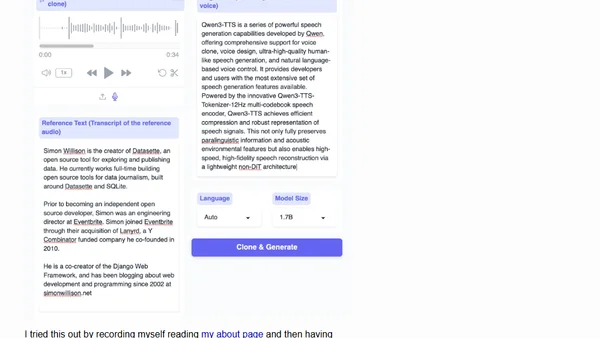
Qwen3-TTS, a family of advanced multilingual text-to-speech models, is now open source, featuring voice cloning and description-based control.
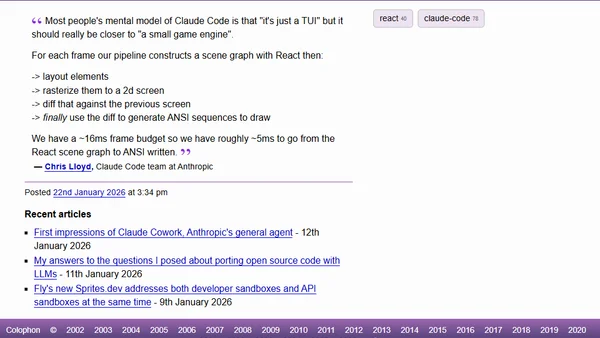
Claude Code is described as a small game engine, detailing its React-based scene graph to ANSI rendering pipeline with a 16ms frame budget.