Proving you know a product
Explains a zero-knowledge proof for verifying a product without revealing the numbers, using elliptic curves and pairings.
John D. Cook provides expert consulting in applied mathematics and data privacy, helping clients from tech, biotech, and legal industries—including Amazon, Google, Microsoft, and Amgen—solve complex problems efficiently.
44 articles from this blog
Explains a zero-knowledge proof for verifying a product without revealing the numbers, using elliptic curves and pairings.
Explains how to construct a zero-knowledge proof to demonstrate knowledge of a discrete logarithm without revealing the secret value.
Explores the Mills ratio, comparing tail behavior of Student t and normal distributions to illustrate fat-tailed vs. thin-tailed distributions.
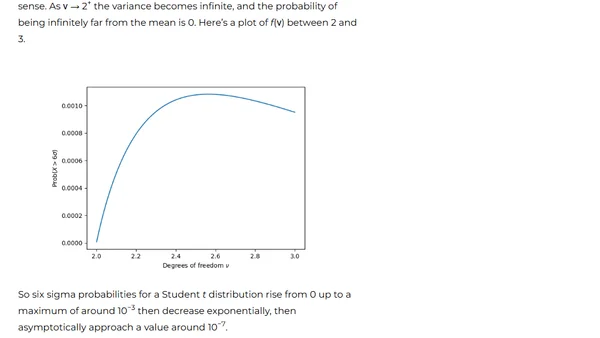
Explores the probability of extreme 'six sigma' events using the Student t distribution, showing it's not monotonic and depends heavily on degrees of freedom.
An introduction to stylometry, the statistical analysis of writing style, with examples from historical texts and natural language processing.
Argues that ugly, legacy code can hold valuable domain knowledge and be more practical to refactor than to rewrite from scratch.
Explores prime gaps, their mathematical merit, and their use as proof-of-work in the Gapcoin cryptocurrency.
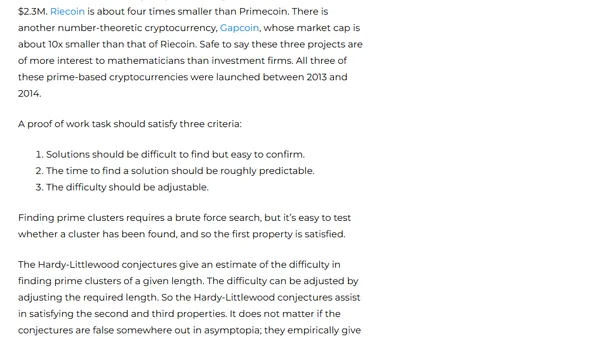
Explores prime clusters, their mathematical definition, and their use as proof-of-work in the Riecoin cryptocurrency.
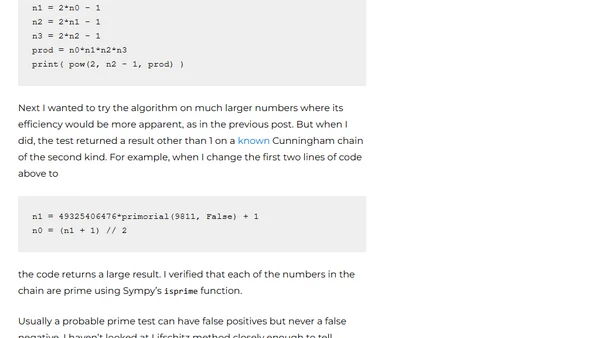
Explores a method for testing Cunningham prime chains efficiently, with applications in cryptocurrency proof-of-work systems.
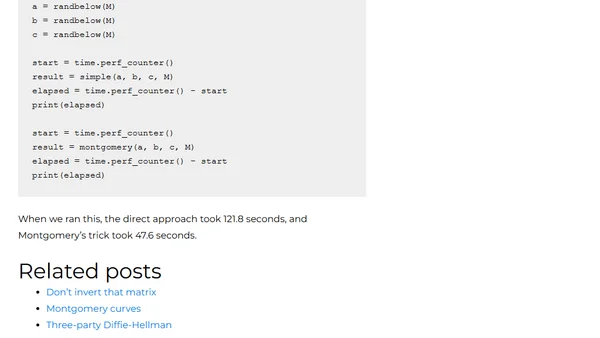
Explains Montgomery's trick for efficiently computing multiple modular inverses at once, with Python code examples and performance comparison.
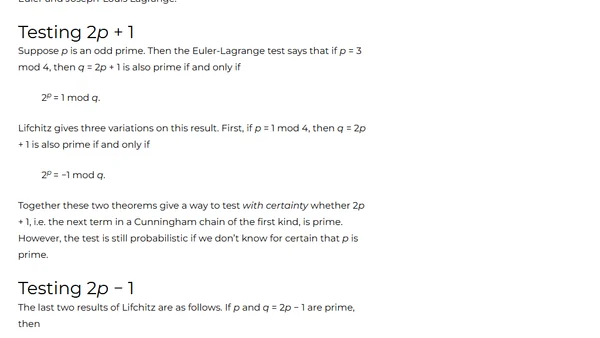
Explains the probabilistic primality tests (Fermat and Euler-Lagrange-Lifchitz) used in Primecoin's blockchain verification and mining process.
Explores bi-twin prime chains, a mathematical pattern where sequences of twin primes follow a doubling rule, with examples and Python verification code.
Explores prime number chains like Cunningham chains and their application in the Primecoin cryptocurrency's proof-of-work system.
Explores compressing sets of hash values using Golomb-Rice coding, detailing the theory and implementation with examples.
A new record for the largest known 'compositorial prime' has been set, a prime number with over 3.7 million digits.
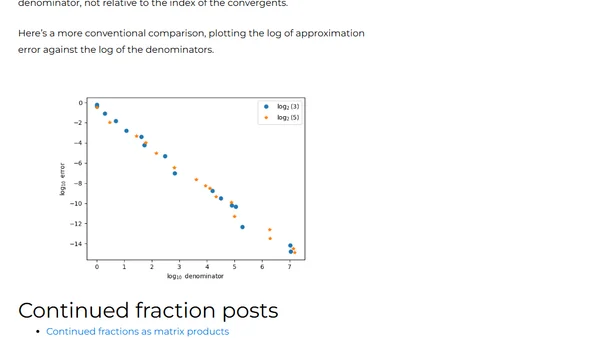
Analyzes the rational approximation of log2(3) and log2(5) using continued fractions, comparing their approximation errors.
Explains the math and Python code for perfect in-shuffles and out-shuffles, comparing how many shuffles restore a deck's order.
Explores the mathematics of card shuffling, contrasting random 'rifle shuffles' with deterministic 'perfect shuffles' and their Python implementation.
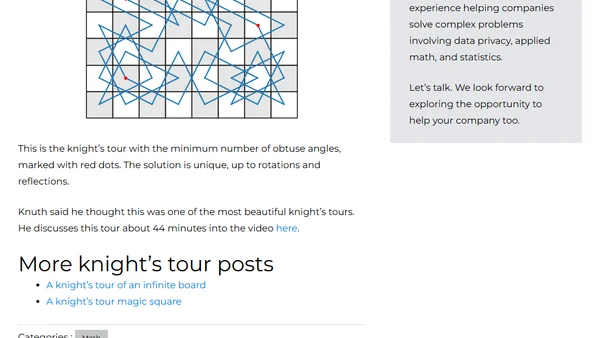
Analysis of a unique knight's tour with minimal obtuse angles, presented by Donald Knuth in his annual Christmas lecture.
Explores why category theory requires collections larger than sets to be interesting, discussing foundational issues and cardinality.