Leaving W3C
Author explains their decision to leave the W3C to focus on personal projects, open source work, writing a book, and standards development.

Discusses the shift away from CSS vendor prefixes as features become stable, and the need to treat experimental features carefully.
The CSS border-corner-shape property is at risk of being removed from the spec. The author calls for developers to provide use cases to help save it.
A guide to using MathML for web equations with a CSS fallback for browsers lacking native support, based on a real-world use case.
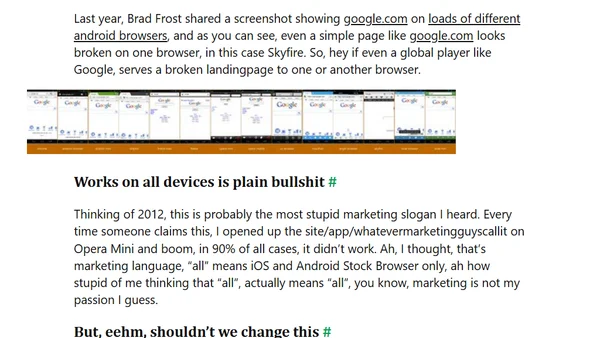
Argues that all web designs are inherently broken due to the vast diversity of browsers and devices, and advocates for future-friendly development practices.
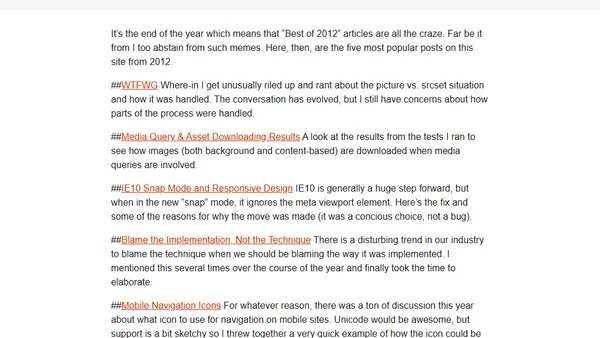
A web developer's 2012 roundup of his most popular posts, covering responsive design, CSS techniques, and web standards debates.
The author expresses excitement for Web Platform Docs, a collaborative project by browser vendors to create unified web development documentation.
Web developer Lea Verou announces joining the W3C team to work on developer relations, web education, and standards design.
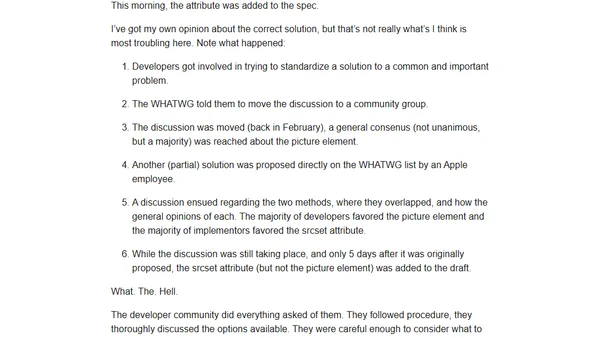
A critique of the WHATWG's process for standardizing responsive images, highlighting developer frustration over the adoption of the srcset attribute.
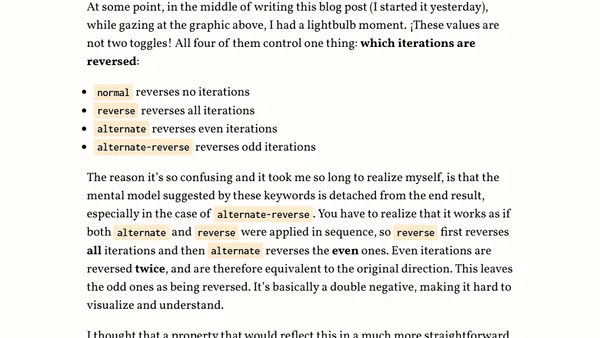
Explores the CSS animation-direction property, its values, and a proposed syntax change for better control over animation iterations.
Critique of non-standard CSS text masking and advocacy for using SVG as a standards-compliant alternative for text effects.
Explains the rules for quoting font family names in CSS, clarifying when quotes are required and when unquoted names are valid.
Analysis of why CSS vendor prefixes create maintenance problems for developers and hinder web standards adoption.
Lea Verou responds to being falsely accused of promoting -webkit-only prefixes and discusses the CSS vendor prefix problem.
An overview of the css3test project, a tool that comprehensively tests browser support for CSS3 features and specifications.
Explores current limitations in web development that cannot be solved client-side, including templating, localization, screen capture, and accessing POST data.
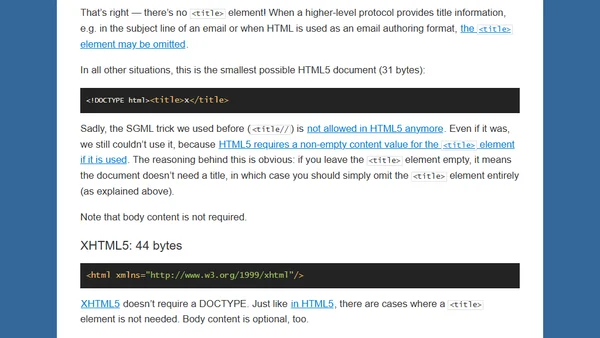
Explores the smallest possible valid (X)HTML documents for various historical HTML versions, detailing byte counts and SGML minimization tricks.
Explains ambiguous ampersands in HTML, detailing character references and validity rules in HTML4 vs. HTML5 specifications.
A curated list of essential RSS feeds for frontend developers, covering JavaScript, web standards, and large-scale web application development.
A deep dive into HTML5 fundamentals, browser parsing rules, and how understanding them can lead to more maintainable markup.