What I don’t like about the AI hype.
A software engineer critiques the 'democratization' of AI in development, arguing it oversimplifies and risks creating fragile software without CS fundamentals.
An article discussing the risks of over-relying on AI for creative work and how it can damage professional credibility and trust.
Explores the ethics of LLM training data and proposes a technical method to poison AI crawlers using nofollow links.
The author argues that traditional piracy is dead, redefined by corporations like Meta using scraped, pirated content to train AI models without consequence.
Explores ethical boundaries and risks of AI, advising where human judgment should prevail over automation.
Data professionals discuss AI anxiety, job security, and the future of tech careers at Data Day Texas 2025.
An analysis of the ethical debate around LLMs, contrasting their use in creative fields with their potential for scientific advancement.
Explores the critical challenge of bias in health AI data, why unbiased data is impossible, and the ethical implications for medical algorithms.
Argues for a balanced approach to AI, using it for discovery but doing important learning and thinking tasks manually to preserve meaning and growth.
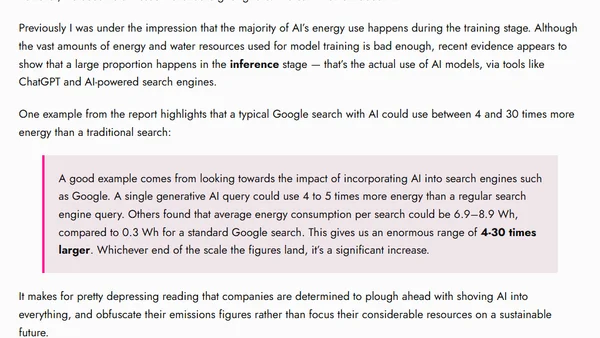
A report reveals the significant environmental impact of AI, especially in inference stages like AI-powered search, using 4-30 times more energy than traditional methods.
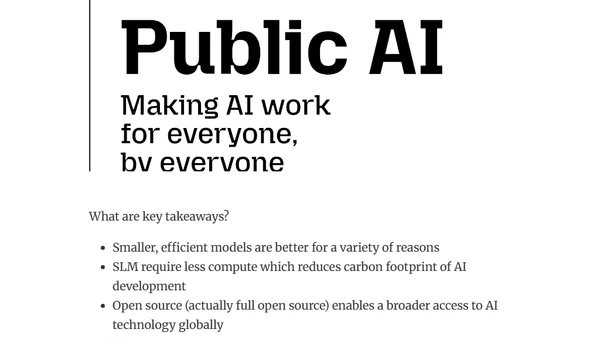
Analysis of Mozilla's public AI paper, highlighting the benefits of small, open-source language models for efficiency, privacy, and global access.
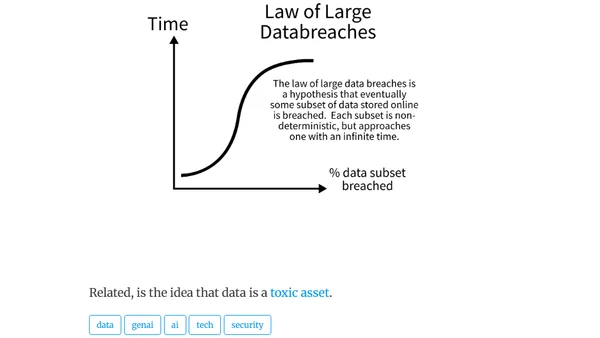
Explores the 'law of large data breaches,' a hypothesis that all online data subsets are eventually breached, relating it to probability and data as a toxic asset.
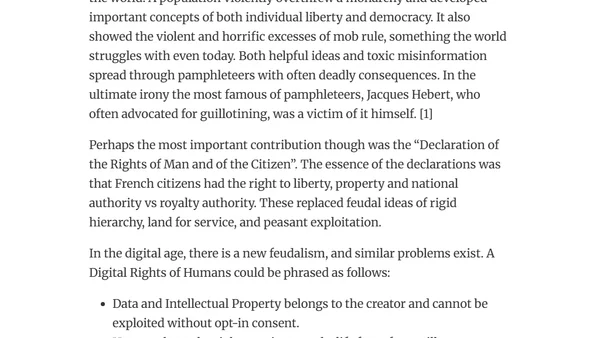
Explores the need for a modern "Digital Rights of Humans" declaration to protect privacy, data ownership, and freedom from algorithmic harm in the AI era.
Argues for an evolved robots.txt standard with AI-specific rules and regulations to enforce them, citing Perplexity AI's violations.
A personal manifesto advocating for a more human-centric, intentional, and ethical web in response to the rise of AI-generated content.
Argues that the term 'Open Source' is misleading for LLMs and proposes the new term 'PALE LLMs' (Publicly Available, Locally Executable).
Explores the concept of 'intellectual debt' in AI and software systems, comparing it to The Sorcerer's Apprentice and arguing for open society principles as a solution.
Analyzes IBM's punch card role in the Holocaust to draw parallels with modern AI risks and corporate ethics in technology.
An opinion piece arguing against using AI-generated images, highlighting ethical concerns and the negative impact on professional illustrators' livelihoods.
A developer argues that AI should focus on automating tedious tasks to free up human energy for creative and meaningful work.