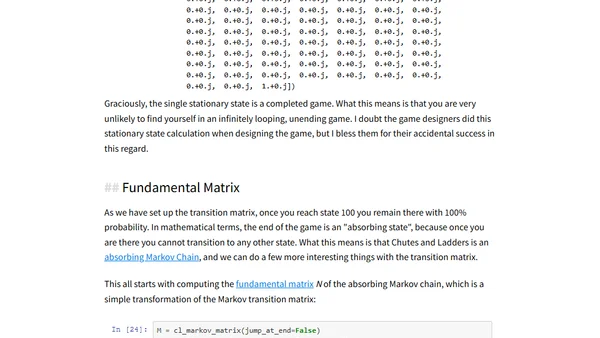
Simulating Chutes & Ladders in Python
A technical analysis of the Chutes & Ladders board game using Python simulation and Markov chain modeling to calculate expected game length.
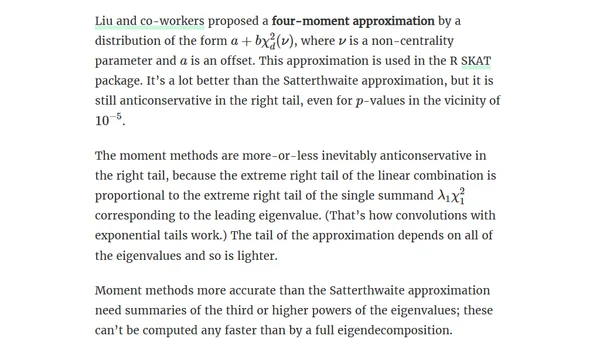
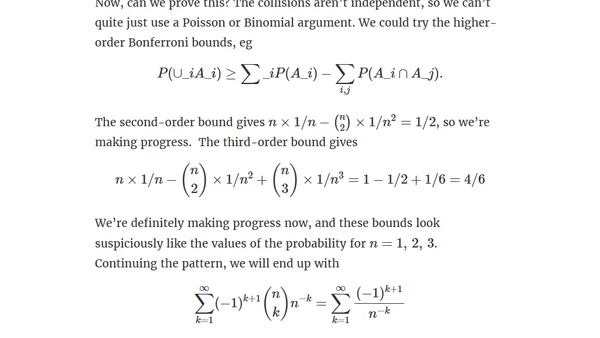
Explores methods for computing tail probabilities of linear combinations of chi-squared variables, focusing on applications in genetics with large datasets.
Analyzing the probability of self-assignment in a Secret Santa gift exchange using probability bounds and simulations.
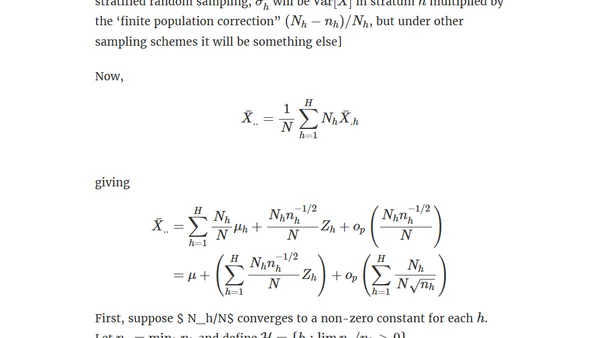
A technical discussion on asymptotic approximations in stratified sampling when sampling probabilities approach zero, relevant for rare disease studies.
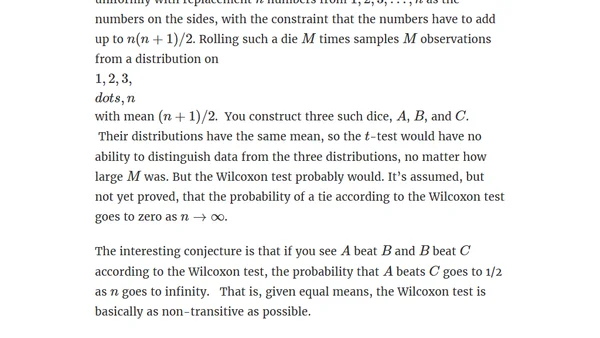
Explores a potential 'Polymath' project on the Wilcoxon test's non-transitive behavior with dice, connecting math and statistics.
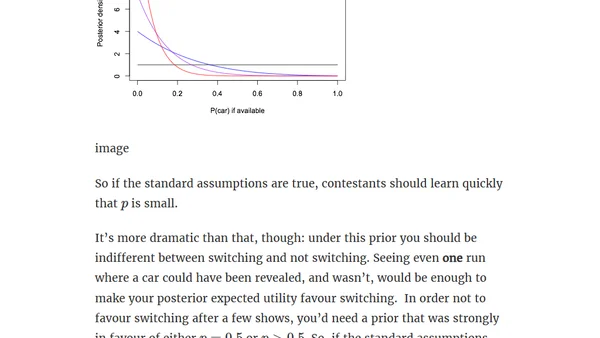
Analyzing the Monty Hall problem, exploring learning strategies and optimal decisions based on observed game history and host behavior.
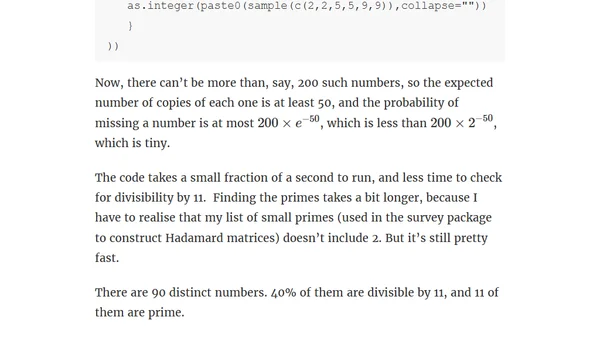
Using R code to generate permutations of digits (2,2,5,5,9,9), analyzing divisibility by 11 and primality.
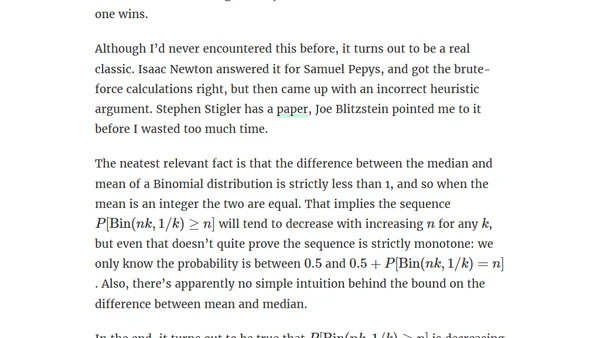
Analyzing a classic probability problem involving dice rolls, its historical context with Newton and Pepys, and the mathematical intuition behind it.
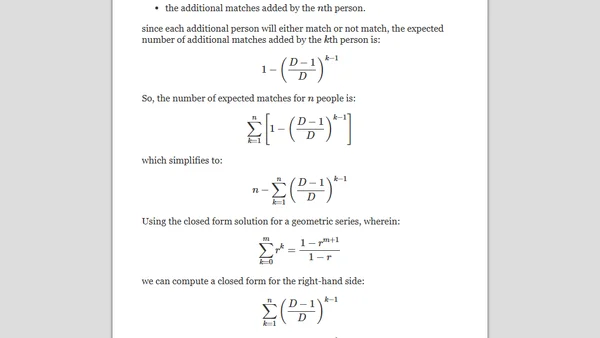
Explains how the birthday paradox applies to hash collisions, deriving the expected number of collisions in a set.
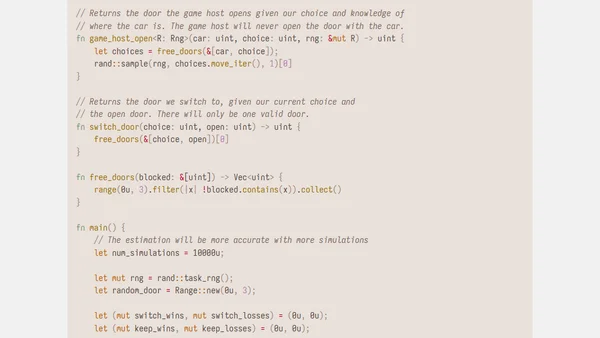
A Rust programming simulation of the classic Monty Hall probability problem, demonstrating the counter-intuitive odds.
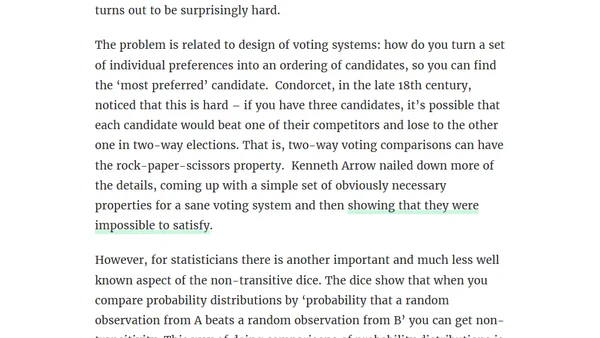
Explores non-transitivity in games like rock-paper-scissors, its history, and connections to statistics, evolution, and voting systems.