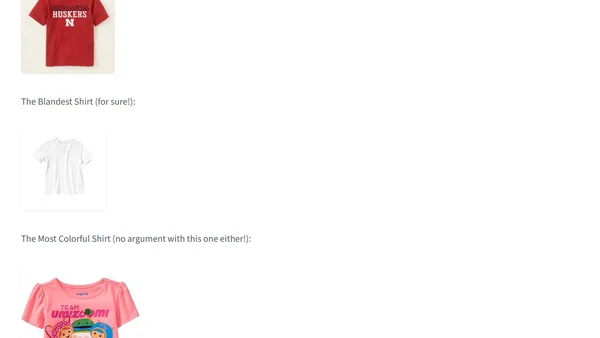
T-Shirts, Feminism, Parenting, and Data Science, Part 1: Colors
A data scientist analyzes gender stereotypes in children's clothing by building a model to classify t-shirts using image processing and color data.
Argues that true data science and innovation require deep mathematical understanding, not just push-button tools, and defends the value of skilled data scientists.
Overview of new features in scikit-learn 0.11, including non-linear models, semi-supervised learning, and sparse models for Python machine learning.
Announcement for a 2-year junior engineer position to work on the scikit-learn machine learning library at INRIA near Paris.
EuroScipy conference in Paris announces program details, keynote speakers, and a new poster session. Submission deadline is May 8th.
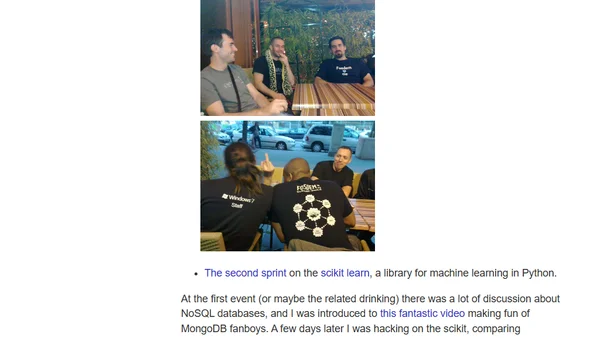
The scikit-learn team announces a community sprint on April 1st for improving the Python machine learning library, with in-person and remote participation.
A research group seeks a post-doc for the AzureBrain project, using Python for parallel computing and statistics on brain imaging/genetics data.
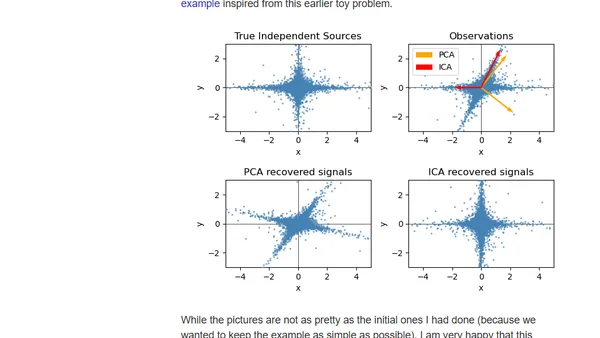
Explains the difference between ICA and PCA using scikit-learn code, advocating for runnable examples over static visuals in scientific materials.
A humorous take on machine learning concepts like overfitting and algorithm comparisons, using Python's scikit-learn library as an example.
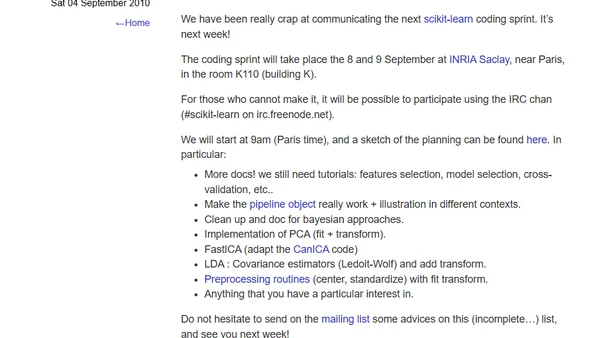
Announcement for the upcoming scikit-learn coding sprint in Paris, including dates, location, remote participation details, and planned tasks.
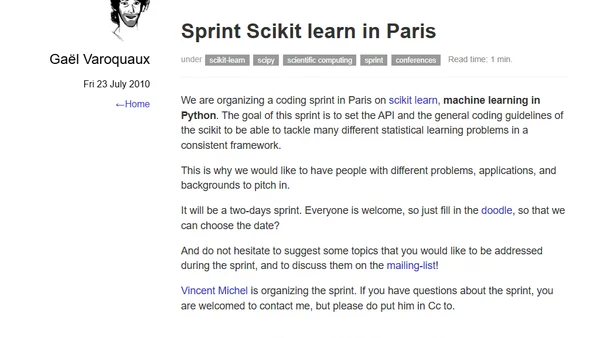
Announcing a two-day coding sprint in Paris focused on scikit-learn's API and development guidelines for machine learning in Python.